Organizing the eAU correctly: How the electronic sick note works
The paper sick note has been gone since 2023. How the eAU procedure works, which response codes exist, and how to organize the process in your business.

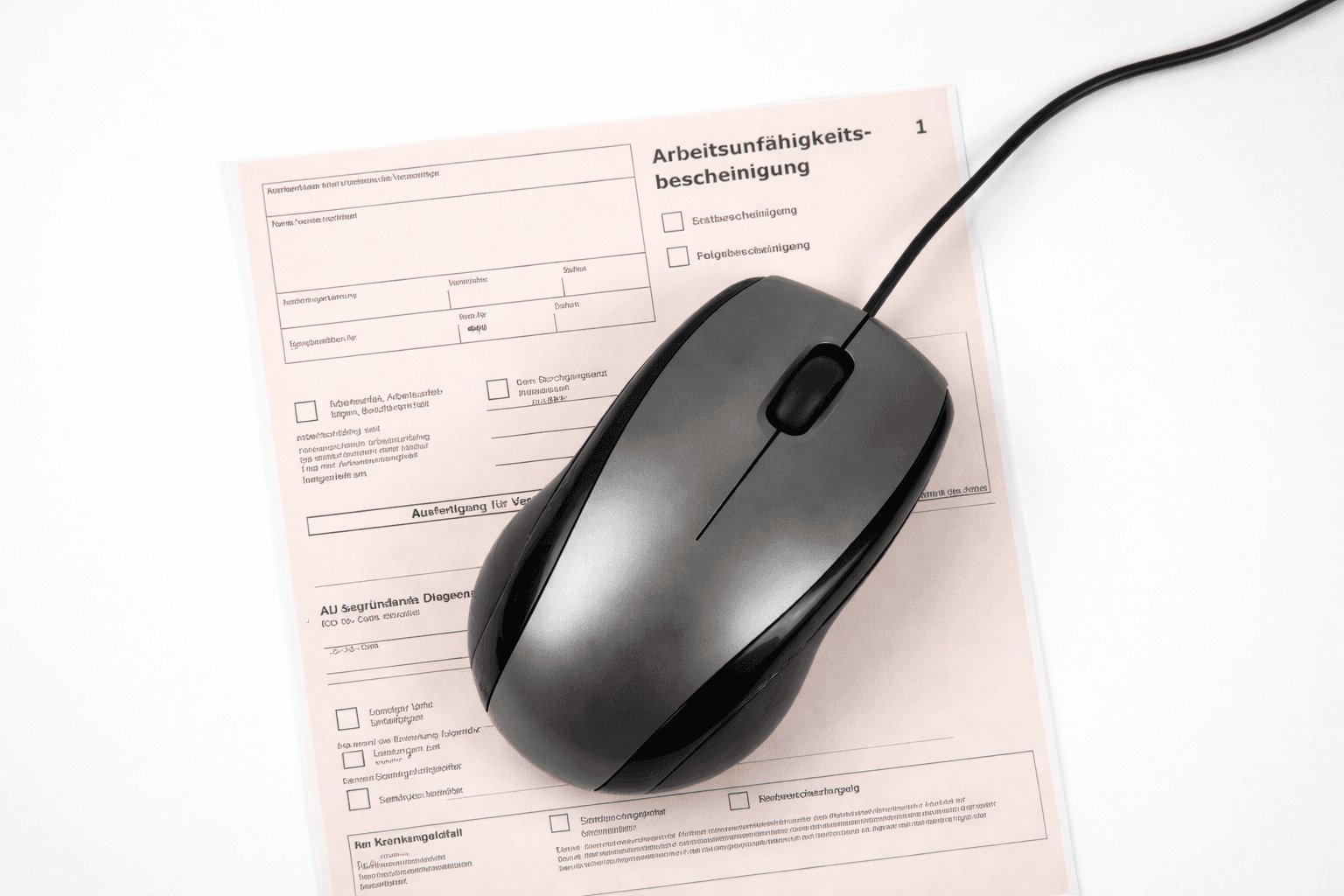
Since January 2023, the paper sick note (the “yellow slip”) no longer exists — at least not for employees with statutory health insurance. Instead, sick notes are transmitted digitally: from the doctor to the health insurer, and retrieved electronically from there by the employer. That sounds simple — but in practice there are pitfalls.
This article shows how the eAU procedure works, what you as an employer have to do, and how to organize the process cleanly in your business.
What is the eAU?
The electronic certificate of incapacity for work (eAU) is the digital sick note. Since January 1, 2023, doctors no longer transmit incapacity-for-work data on paper, but electronically to the insured person's health insurer. The employer then retrieves the data from the health insurer.
What has changed
The employee no longer hands the employer a paper slip. However, the employee still informs the employer about the sick leave and its expected duration. The employer then retrieves the data electronically.

How the eAU procedure works
The process in three steps:
Doctor determines incapacity for work
The doctor determines the incapacity for work and transmits the data electronically to the insured person's health insurer. The patient still receives a printout for their own records.
Employee informs the employer
The employee reports sick without delay and states the expected duration — by phone, email, or in the system. A paper certificate is no longer required.
Employer retrieves the eAU
The employer queries the incapacity-for-work data from the health insurer — via a payroll program or the SV reporting portal (sv.net). The health insurer transmits the data electronically.
What the employer has to do
The eAU procedure brings new obligations for employers:
- Electronic retrieval: Employers are generally required to retrieve the incapacity-for-work data electronically from the health insurer. For those with statutory health insurance, the paper slip no longer has to be presented.
- System requirement: Retrieval only works through a certified payroll program or the SV reporting portal. A manual query by phone or email is not possible.
- Prompt retrieval: According to the health insurers, the data is generally available for retrieval for about 42 days. A prompt retrieval is therefore advisable.
- Documentation: The retrieved data should be documented in HR and taken into account for continued pay during illness.
What the employee has to do
Even though the yellow slip is gone, one central obligation remains:
The reporting obligation remains
The employee must still inform the employer without delay about the incapacity for work and its expected duration. The eAU procedure only replaces the paper certificate — not the duty to inform.
In practice this means: the employee calls in the morning, writes an email, or reports sick in the system. Only then can the employer retrieve the eAU data from the health insurer.
Response codes: what the health insurer reports back
When you query the eAU, you don't always receive the incapacity-for-work data right away. The health insurer responds with a response code that tells you what is on file:
| Code | Meaning | What to do? |
|---|---|---|
| 2 | Incapacity-for-work data available | Take over the data, check continued pay during illness |
| 3 | Inpatient hospital stay | Note the discharge date |
| 4 | Certificate not (yet) available | Wait; the health insurer generally checks for about 14 days |
| 5 | Rehabilitation/preventive care (since 2025) | Take over the stay data |
| 7 | Under review by the health insurer | According to the health insurers, this can take up to 28 days |
| 8 | Other certificate (private doctor, abroad) | Ask the employee |
| 9 | Forwarding procedure (change of insurer) | Wait 14 days |
Tip: Code 4 is the most common problem case
If you receive code 4 on the query, it does not mean the employee isn't sick. It means the data hasn't reached the health insurer yet. That can take 1–3 days. Simply query again.
Manage sick leave digitally
Shiftdesk helps businesses manage absences. Try it free for 14 days.
How to organize the eAU process in your business
For the internal notification, use the sickness notification template in DOCX or PDF format. It brings together the absence period, eAU status and cover arrangements; retrieving the eAU remains a separate step.
Define the reporting path
Define a clear reporting path: who is notified (team lead, HR), through which channel (phone, email, app), and by when (before the start of the shift).
Set up a retrieval routine
Establish a fixed rhythm for retrieving the eAU — ideally daily or with every new sick note. That way you won't miss any data.
Know the response codes
Not every query returns results immediately. Familiarize yourself and your team with the codes (see table above) — especially code 4.
Organize cover in the schedule
As soon as the sick note comes in: plan cover, reassign the shift, inform the affected employees.
Document continued pay during illness
Based on the eAU data, document the continued pay during illness. For longer illnesses, clarify the further coverage with the health insurer or your tax advisor.
Common problems and solutions
Employee doesn't report sick
The eAU does not replace the reporting obligation. If an employee simply doesn't show up and doesn't get in touch, there is no basis for the eAU retrieval. Communicate clear rules and consequences.
eAU data not retrievable (code 4)
Often the reason is that the doctor hasn't transmitted the data yet. As a rule, the data is available 1–3 days after the doctor's visit. Query again.
Privately insured employees
The eAU procedure only applies to those with statutory health insurance. Privately insured employees still need a paper certificate. Map both paths in the process.
Long-term sick and follow-up certificates
For follow-up certificates (extensions), a new retrieval is required. Keep an overview of ongoing sick notes — ideally with a digital system.
Managing sick leave with Shiftdesk
Shiftdesk can support the internal part of the sick-leave process — that is, the steps that happen before and after the eAU retrieval:
Record the sick note
Document absences with type (sick, vacation, special leave), period, and status.
Adjust the schedule
The sick note is visible directly in the schedule. Plan cover and fill open shifts.
Scope
Shiftdesk is not a payroll program and does not replace the eAU retrieval from the health insurer. For the electronic retrieval of the incapacity-for-work data, you still need a certified payroll system or the SV reporting portal. Shiftdesk complements this process on the organizational side.
Frequently asked questions about the eAU
Does the employee still have to submit a sick note?
The employee is still required to inform the employer without delay about their incapacity for work and its expected duration. The paper sick note (the "yellow slip") no longer exists for those with statutory health insurance — the employer retrieves the data electronically from the health insurer.
How do I retrieve the eAU data?
Retrieval is done through a certified payroll program or the SV reporting portal (sv.net). The query requires the employee's name, social security number, and the requested period.
What do I do if the eAU query returns no result?
There can be several reasons: the doctor's visit hasn't taken place yet, the data hasn't reached the health insurer yet, or there is a response code 4 (no certificate available). As a rule, the data is supplied within a few days.
Does the eAU also apply to those with private health insurance?
No, the eAU procedure only applies to those with statutory health insurance. Privately insured employees still receive a paper certificate from their doctor, which they present to the employer.
How long is eAU data stored at the health insurer?
According to the health insurers, the data is generally available for retrieval for about 42 days. After that, it may no longer be available. A prompt retrieval is therefore advisable.
Conclusion
The eAU simplifies the sick-leave process — but only if the operational workflow is set up for it. Those who define clear reporting paths, retrieve the eAU as a routine, and know the response codes avoid most of the problems.
For the organizational part — recording the sick note, planning cover, documenting absences — digital absence management such as Shiftdesk can complement the process.
This article is for general information only and does not constitute legal advice. The presentation is based on the German Continued Remuneration Act (EFZG) and the statutory health insurers' requirements for the eAU procedure (as of April 2026). The specific workflows may differ depending on the payroll system and health insurer. The presentation refers to German law and those with statutory health insurance. Shiftdesk assumes no liability for the accuracy, completeness, or timeliness of the content presented.
The Shiftdesk team writes about scheduling, time tracking and labor law in the DACH region — practical and easy to follow.
Related to this topic
Take the next step with the relevant Shiftdesk solution or a free tool.
More articles

Leave Planning in the Company: How to Organize Absences in a Structured Way
Leave requests, company-wide shutdowns, remaining leave — how to organize leave planning fairly, transparently and without conflict. With practical tips and a checklist.

Time-Tracking Obligation 2026: What Employers Need to Know and Do Now
The obligation to record working time already applies — even without a new law. What the BAG ruling means, which form is permitted, and how to act correctly as an employer right now.

Outsourcing Payroll in Germany: Tax Advisor or Payroll Office? [2026]
Tax advisor, payroll office or in-house? Costs under § 34 StBVV, an honest comparison, and how to hand payroll data to your firm digitally instead of via paper binders.