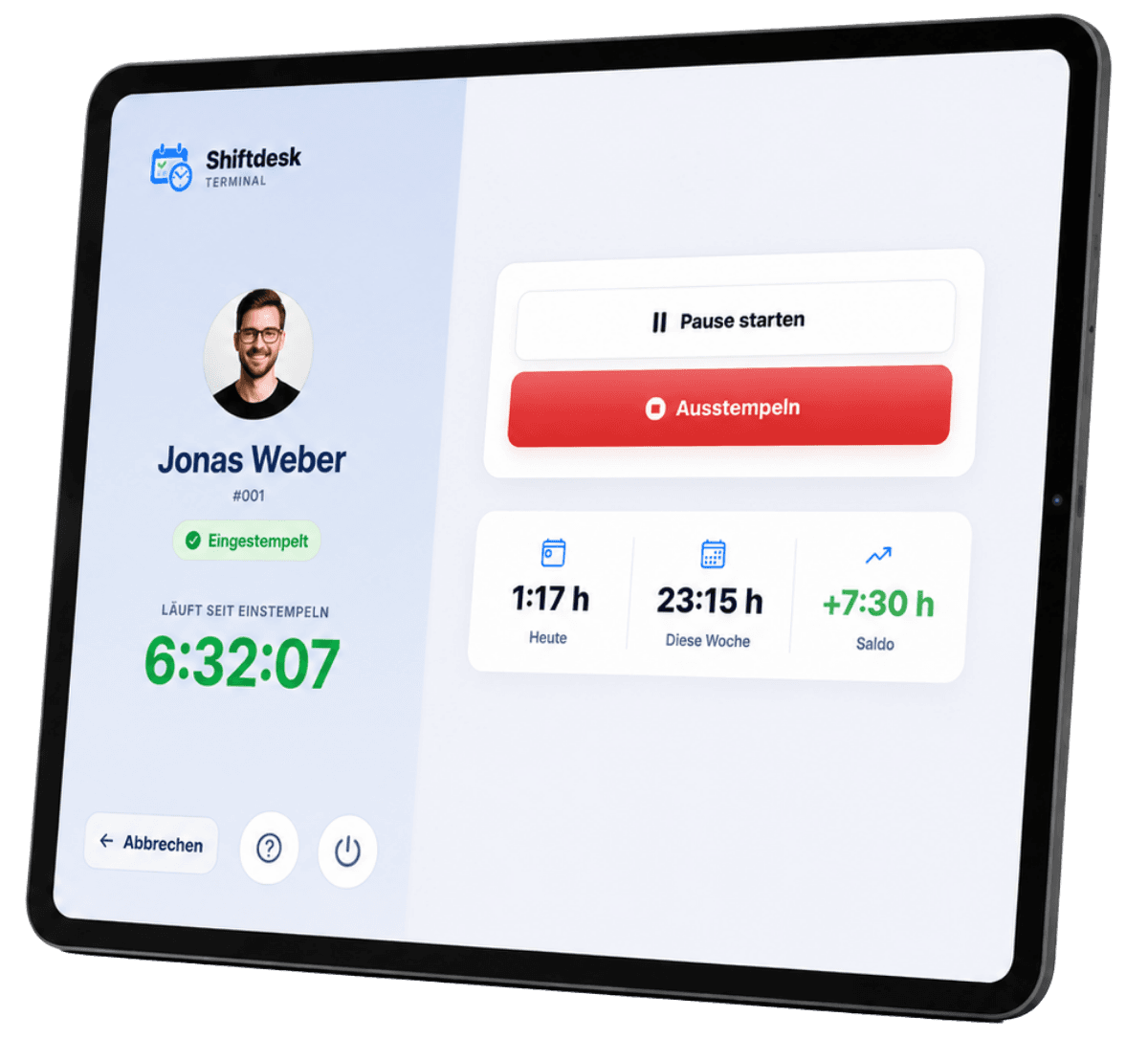
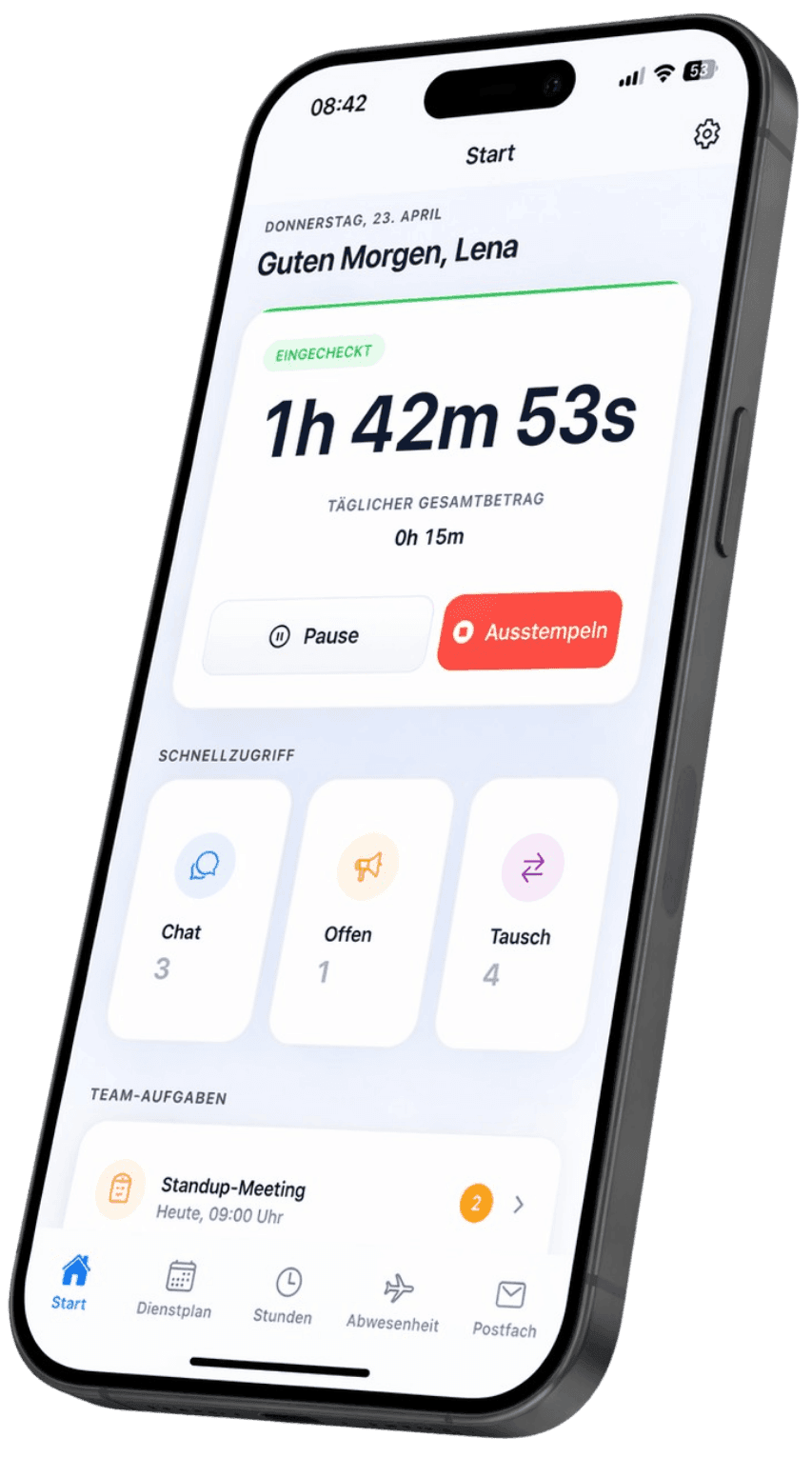
Time tracking for employees – simple, digital, traceable.

Record hours via app, browser or time clock. Automatic hours account, break calculation and a link to the schedule – the digital time tracking that fits your business.

No credit card Β· Built on GDPR principles Β· Hosted in Frankfurt

Time tracking for employees – digital time clock in the office
Built on GDPR principles
ArbZG break calculation
Hosted in Frankfurt (EU)
256-bit encryption

Time tracking that fits your business

From the time clock to the hours account – all in one time tracking app.

Timer & manual entry

One-click start/stop or after-the-fact entry with an approval workflow. Both modes document start, end and duration.

Automatic break calculation

Break reminders based on ArbZG principles: 30 minutes from 6 hours, 45 minutes from 9 hours of working time.

Hours account with target vs. actual

Plus and minus balances per employee at a glance. Monthly and yearly overview for payroll preparation.

Mobile time tracking (app)

Clock in on the go – for field staff, shift workers and mobile teams. Time tracking app for iOS and Android.

Export for payroll

Recorded hours exportable as CSV for payroll preparation. Compatible with common payroll systems.

Link to the schedule

Target times from the schedule, actual times from tracking – automatic reconciliation in one system. That's the difference.

Want to quickly check a shift by hand? The free break & rest-period calculator shows the minimum break and the earliest next shift start.

Digital time tracking in production – employee time tracking

Simple, transparent pricing

Base fee plus a fair per-employee tier. All prices are net, plus VAT.

Basic

€25

per month Β· 6 employees included

  • Shift scheduling with drag and drop
  • Time tracking (timer + manual)
  • Absences with leave balance
  • Up to 3 locations
Start free trial
Popular

Pro

€45

per month Β· 12 employees included

  • All Basic features
  • Unlimited locations
  • Payroll preparation & DATEV
  • Tablet time clock (kiosk mode)
Start free trial

Enterprise

€120

per month Β· 30 employees included

  • All Pro features
  • Public REST API
  • Budget management & custom fields
  • SLA support (8-hour response time)
Contact us
See all details and pricing calculator

All prices exclude VAT Β· Cancel anytime Β· No credit card required

Why digital time tracking is essential in 2026

Organizing employee time tracking systematically has not been an optional task since the German Federal Labour Court ruling of September 2022. Employers in Germany are generally obliged to record their staff's working hours. The exact statutory framework is still pending, but the need to act already exists today. Anyone without a system risks disadvantages in the burden of proof in labour court proceedings and possible fines during audits.

Digital time tracking – whether as a time tracking app, browser time clock or terminal – can provide a solid foundation. It documents the start, end and duration of daily working time and at the same time enables the calculation of overtime, break times and hours balances. Read more in our article on the time tracking obligation 2026.

For businesses that already run an hours account or want to introduce one, combining time tracking and an hours account in one system is especially valuable – no duplicate data entry, no transfer errors, one central overview.

Time tracking via app, browser or time clock: which method fits?

Not every workplace is the same – and not every tracking method fits every team. Here are the three most common approaches at a glance:

MethodSuitable forAdvantagesDisadvantages
Mobile appField service, trades, shift workersFlexible, GPS, offline-capableSmartphone required
Browser time clockOffice, home office, agenciesNo download, usable at the PCRequires internet access
Tablet terminalReception, warehouse, productionFixed location, simpleHardware costs

Many businesses combine several methods: an app for field service, a browser for the office, a terminal at the entrance. What matters is that all data comes together in one system – for a unified hours account and accurate payroll preparation.

Time tracking and shift scheduling: why they belong together

Most time tracking tools work in isolation: they document hours but know nothing about the schedule. That means duplicate data entry, manual target-vs-actual comparisons and no automatic detection of plan deviations. For employee time tracking in shift operations or with changing working hours, that's a real problem.

Shiftdesk combines shift scheduling and time tracking in one system. The target times come from the schedule, the actual times from tracking – the reconciliation happens automatically. The result: one hours account per employee that is always up to date, and alerts on deviations directly in the system.

That sets Shiftdesk apart from pure time tracking tools and from pure scheduling tools. For general shift scheduling there is our page create a schedule online. For businesses with fixed shift models the shift scheduler online. And for the software comparison the blog article time tracking software compared. And for the clock-in feature the digital time clock.

GDPR requirements for digital time tracking

Anyone using a time tracking app processes personal data – and must comply with the requirements of the GDPR. For choosing a solution, that means specifically:

EU hosting: Personnel data should be stored on servers within the EU. Shiftdesk is hosted in Frankfurt.

DPA (data processing agreement): Under Art. 28 GDPR, a DPA between employer and software provider is generally required. It governs how the provider handles the data.

Data minimisation: Only the data actually needed for time tracking should be recorded. GPS tracking without the explicit consent of employees is generally not permitted.

Access rights and retention periods: Not every employee needs access to all data. Role-based rights and defined retention periods after the storage obligation expires are part of the standard.

You'll find a detailed comparison of various time tracking solutions for SMEs in the time tracking software comparison 2026.

Introducing digital time tracking: the first 7 days

Introducing a time tracking app doesn't have to be a major project. With the right system you can get started in just a few days:

Day 1–2: set up the system. Add employees, store contract types and weekly hours, define work areas.

Day 3–4: test run with a small team. One department or branch goes live. Gather feedback, answer questions, adjust processes.

Day 5–7: rollout and fine-tuning. Invite all employees, hand out app access, make the final adjustments. From now on digital time tracking runs in regular operation.

The advantage: unlike complex enterprise systems, SMEs don't need weeks of implementation. Most teams are productive within a week.

Frequently asked questions about digital time tracking

Is digital time tracking mandatory in 2026?β–Ό
The German Federal Labour Court ruled in 2022 that employers are generally obliged to systematically record their staff's working hours. The exact statutory framework is still pending, but the need to act already exists. Read more in our article on the time tracking obligation.
What does digital time tracking cost?β–Ό
Costs vary by provider and team size. Shiftdesk starts at €25/month plus VAT (6 employees included). There is a 14-day free trial with no credit card.
Which time tracking method suits my business?β–Ό
It depends on the workplace. Mobile teams need a time tracking app, office staff a browser time clock, fixed locations a tablet terminal. Many businesses combine several methods.
Can I use time tracking and shift scheduling in one system?β–Ό
Yes. Systems like Shiftdesk connect shift scheduling and time tracking so that target times from the schedule are automatically reconciled with the recorded actual times. That saves duplicate data entry.
Is time tracking via Excel still permitted?β–Ό
In principle, the law does not prescribe a specific method. However, under case law the tracking must be objective, reliable and accessible. Excel can do this in individual cases, but it is error-prone and hard to evaluate.
What GDPR requirements must time tracking meet?β–Ό
EU hosting, a DPA (data processing agreement), data minimisation (only necessary data), role-based access control and retention periods. Shiftdesk is hosted in Frankfurt and built on GDPR principles.

Ready for digital time tracking?

Start your 14-day trial now – free and with no credit card.

Time tracking for employees – simple, digital, traceable | Shiftdesk