Working-time recording obligation? Shiftdesk supports you
Since the ECJ ruling and the German Federal Labour Court (BAG) decision, employers must record working time. Shiftdesk records working time electronically and, when planning, automatically flags rest periods, maximum working hours and breaks under ArbZG — as informational support, not legal advice.
* Informational notes based on statutory default values (ArbZG, MiLoG). Not legal advice. Collective-bargaining, company-specific and individual special arrangements must be reviewed on your own responsibility.
What sets Working-time recording & ArbZG apart with Shiftdesk
Electronic working-time recording
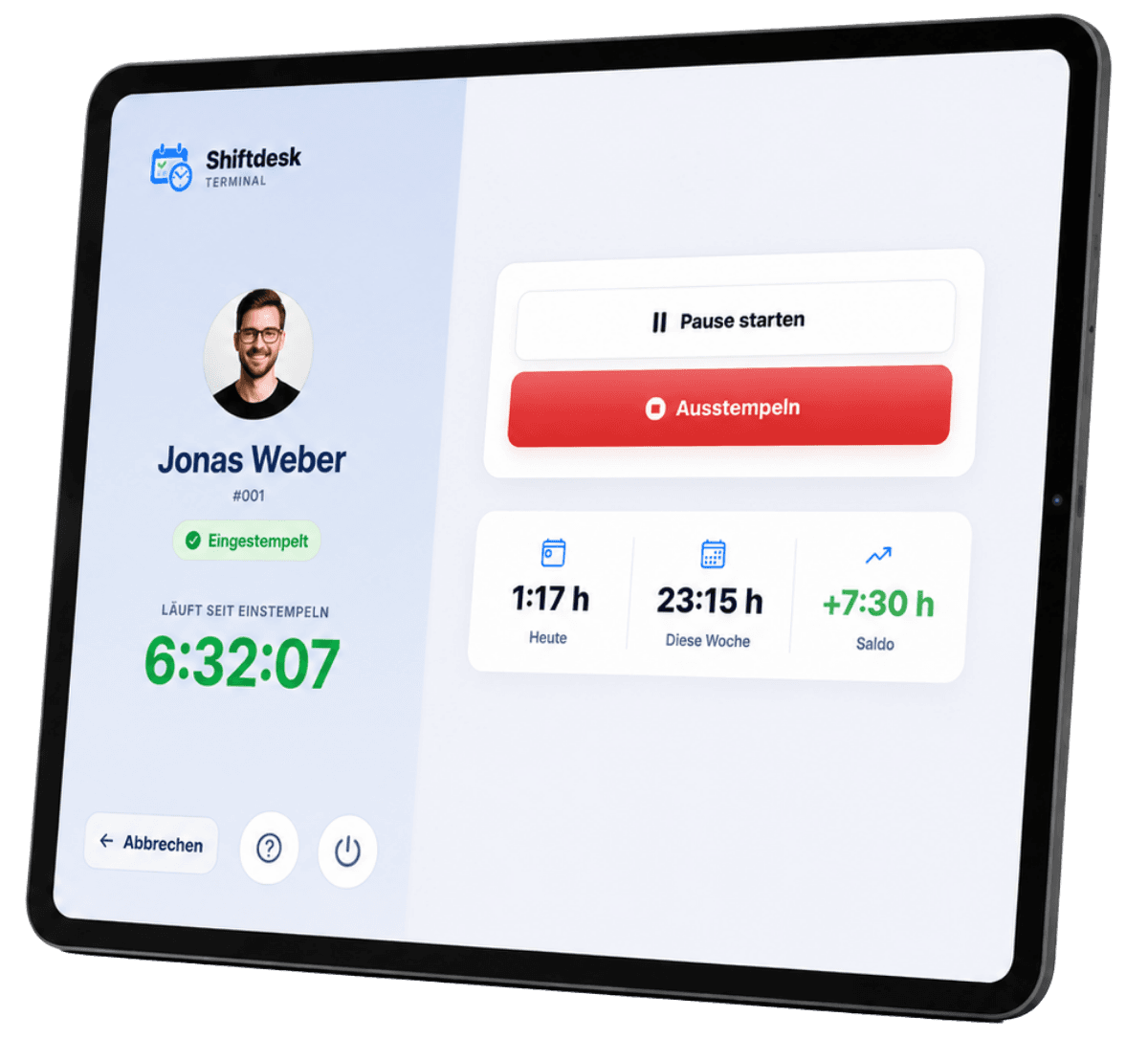
Staff record clock-in, clock-out and breaks via app, browser or tablet. Every entry is documented digitally — the basis for the working-time record.
Rest-period notice (ArbZG § 5)
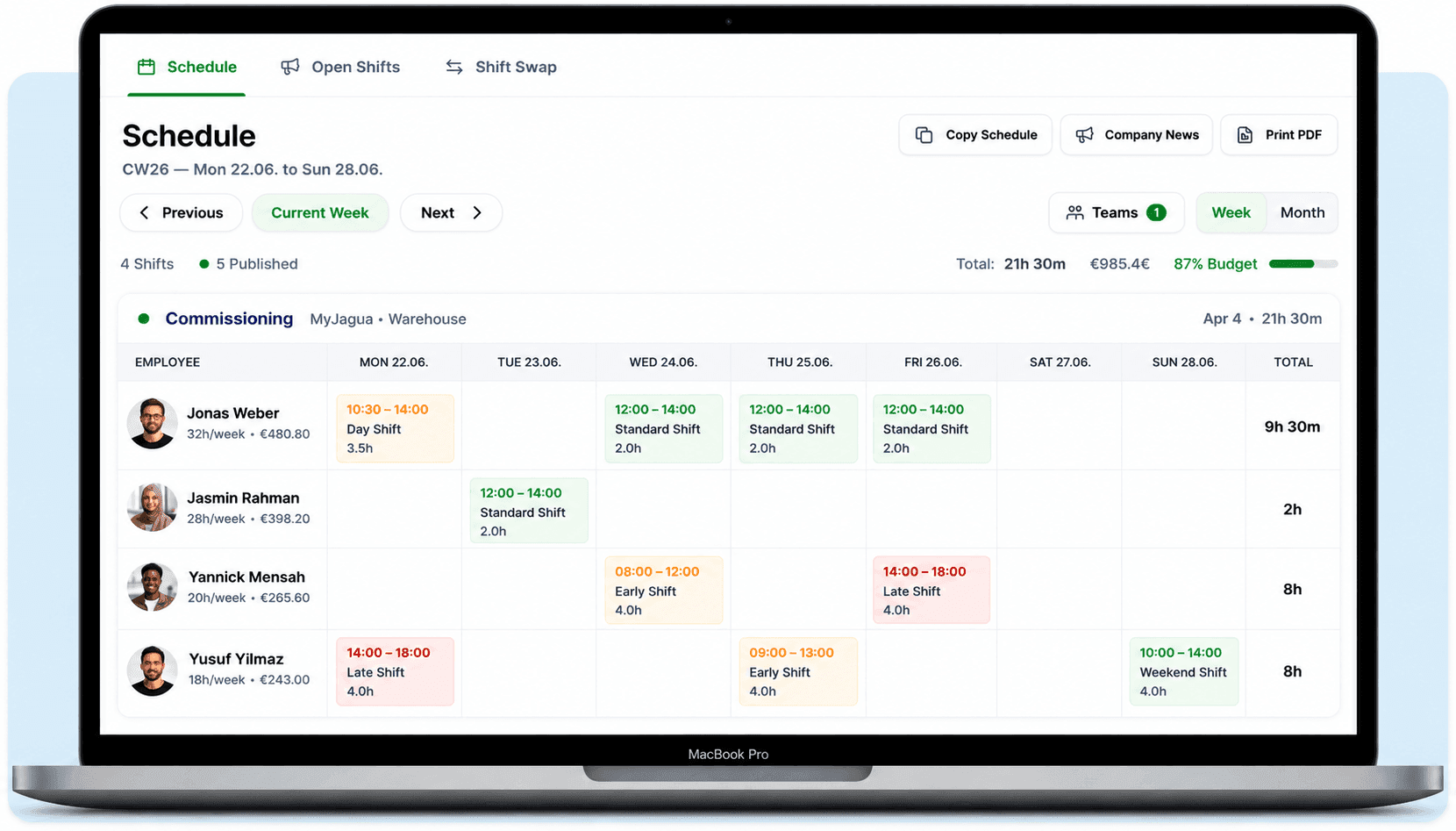
When planning, Shiftdesk flags fewer than 11 hours of rest between two shifts. Visible right in the schedule.
Daily maximum working hours (§ 3)
Guideline 8 hours, max. 10 hours per day. Shiftdesk flags possible excesses instantly and shows the remaining capacity.
Weekly hours & breaks (§ 4)
Notice on the 48-hour weekly average and on mandatory breaks (30 min from 6 h, 45 min from 9 h). Shiftdesk calculates them automatically and flags possible deviations.
Mini-job limit in view
A notice when mini-job workers approach the monthly earnings cap (linked to the minimum wage since 2022) — in good time before the limit is reached.
Working-time record & documentation
Complete records per employee and period, exportable for internal documentation and payroll prep (incl. DATEV format).
Ideal for these industries
Working-time recording & ArbZG with Shiftdesk is especially suited for:
Working-time recording: an obligation since the ECJ and BAG
The European Court of Justice (2019) and the German Federal Labour Court (decision 2022) made clear: employers are obliged to record their employees' working time — start, end and duration, including overtime. Pure trust-based working time without any recording generally does not meet this obligation.
Shiftdesk records working time electronically and makes adherence to the ArbZG benchmarks visible during planning. The notices shown are based on statutory default values and are organizational support — they do not replace legal advice. Collective-bargaining and company-specific rules are reviewed on your own responsibility.
Who is obliged to record working time?
The obligation applies in principle to all employers in Germany, regardless of company size. Exactly how recording must be structured depends on a possible new working-time law and on industry, collective agreements and works agreements. It is best to clarify the precise scope for your business under employment law.
Trust-based working time despite the obligation?
Trust-based working time remains permitted — but the working time performed must still be recorded. The two are not mutually exclusive: staff record their own times (via app or terminal) without every hour being individually ordered. Shiftdesk supports this model with simple self-recording and a traceable hours account.

Electronic working-time recording vs. paper and Excel
A specific form of recording is not yet mandatory — paper or Excel are generally possible too. In practice, manual solutions quickly reach their limits: error-prone, hard to analyze and barely robust when questions arise. Electronic working-time recording makes the documentation complete, analyzable and audit-friendly.
| Kriterium | Paper / Excel | Electronic (Shiftdesk) |
|---|---|---|
| Recording | manual, after the fact | live via app, browser, tablet |
| Breaks | calculate yourself | calculated automatically |
| ArbZG notices | none | visible when planning |
| Analysis & export | tedious | one click, incl. DATEV |
| Traceability | low | completely documented |
Working-time record: document it completely
At the core of the obligation is a robust working-time record: who worked when and for how long? Staff record clock-in, clock-out and breaks via smartphone app, browser time clock or tablet terminal. Shiftdesk documents every entry, calculates mandatory breaks and keeps an hours account per employee.
You export the working-time record for internal documentation and payroll prep (incl. DATEV format) — a common, practical way to put the recording obligation into practice.
Industries, exceptions and practice with Shiftdesk
Whether hospitality, care, manufacturing, logistics, retail or security services — wherever people work in shifts, clean working-time recording is especially valuable. When planning, Shiftdesk flags possible conflicts with rest periods, maximum working hours and breaks right in the schedule.
There are industry-specific exceptions — for example, rest periods can be shortened to ten hours in certain areas if compensated accordingly (§ 5 (2) ArbZG). You review such special cases and collective-bargaining deviations on your own responsibility; Shiftdesk provides the notices as guidance, not as a final assessment.
FAQ on the working-time recording obligation
Is there an obligation to record working time?
Since when does the working-time recording obligation apply?
Does working-time recording have to be electronic?
Are there fines for failing to record working time?
Does the obligation also apply to mini-jobbers and home office?
Does Shiftdesk provide automatic ArbZG notices?
How does Shiftdesk support the working-time record?
Ready for better shift scheduling?
Start your 14-day free trial now — free and no credit card required. Or book a personal demo.